
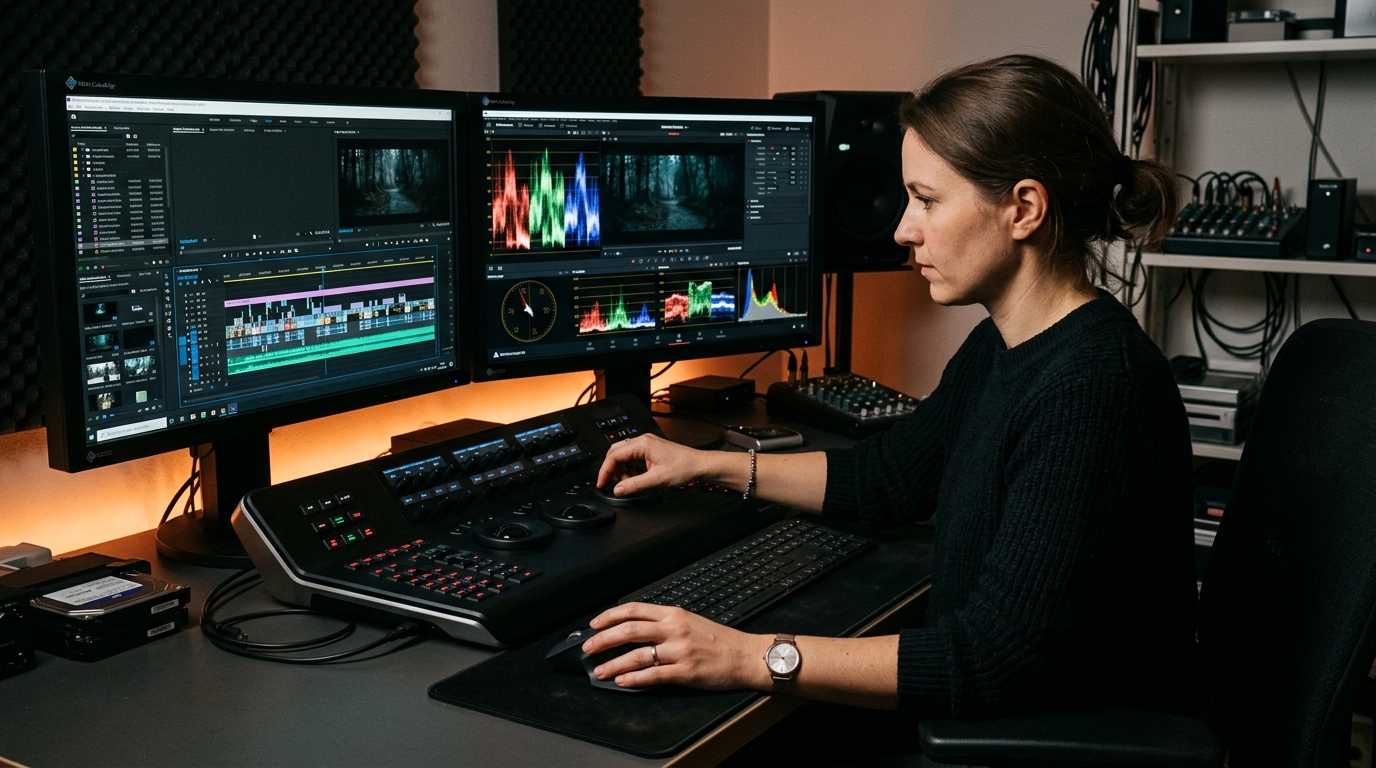

Video as the Dominant Medium of Modern Communication
Video content now represents over 82% of all consumer internet traffic. From high-budget cinematic commercial campaigns and YouTube documentaries to rapid short-form Reels and TikToks, motion picture storytelling is the most influential medium on Earth.
However, anyone can slice a video clip in a basic phone app. Professional video editing is an art form rooted in emotional narrative psychology, precise auditory rhythm, seamless color science, and dynamic visual retention hooks.
Top video editors and motion designers are in soaring demand because they possess the rare ability to command human attention in an era of infinite digital distraction.
The Editor MantraGood editing is invisible; great editing is unforgettable. Every cut must be motivated by narrative information, emotional reaction, or musical rhythm.
The 5 Stages of Professional Post-Production Workflow
Approaching large editing projects without an organized workflow leads to creative paralysis, missing media links, and catastrophic deadline misses.
- Ingestion & Proxy Generation: Organize media into strict bin hierarchies and transcode 4K/6K RAW clips into lightweight ProRes/DNxHR editing proxies for buttery smooth playback.
- Assembly Cut: Lay down the primary storyline or dialogue interview along the timeline without music or effects to verify narrative cohesion.
- Rough Cut & Pacing Refinement: Cut out redundant pauses, add B-roll cutaways to hide jump cuts, and align visual transitions with soundtrack cadence.
- Fine Cut & Sound Design (Picture Lock): Layer foley sound effects, ambient room tones, whooshes, risers, and vocal dialogue de-noising before locking visual edits.
- Color Grading & Finishing Delivery: Perform primary balance, skin tone matching across multiple cameras, creative film look emulation, and final high-bitrate encoding.
Industry Editing Suites Comparison
| Editing Software | Core Strength | Color Science Capabilities | Motion Graphics | Industry Position |
|---|---|---|---|---|
| DaVinci Resolve Studio | Unmatched Color Grading & Audio (Fairlight) | Hollywood Standard (32-bit float YRGB) | Built-in Fusion Nodes | Rapidly Becoming #1 Worldwide |
| Adobe Premiere Pro | Ecosystem Integration with After Effects | Lumetri Color (Very Capable) | Dynamic Link with AE | Dominant in Agency & YouTube Workflows |
| Apple Final Cut Pro | Blazing M-Series Mac Performance | Clean Color Wheels & Curves | Apple Motion Integration | Popular with Solo Creators & Fast Turnaround |
| Adobe After Effects | 2D/3D Motion Design, VFX, Compositing | Full ACES & OCIO Color Support | Undisputed World Standard | Indispensable for Motion Designers |
Color Grading Science: From Log Gamma to Rec.709
Modern cinema cameras record in flat Log color profiles (Sony S-Log3, Canon C-Log, Blackmagic Gen 5) to preserve dynamic range in bright highlights and deep shadows. Beginners make the mistake of slapping random third-party creative LUTs on raw Log footage, resulting in clipped highlights and noisy skin tones.
Professional colorists follow a calibrated pipeline: establish correct input color space transforms (CST) to Rec.709, balance exposure and white balance using waveform monitors, align skin tones along the vectorscope indicator line, and only then apply subtle creative film emulation.
Viral Short-Form Retention Architecture (Reels, TikTok, Shorts)
Editing for short-form algorithms requires distinct psychological pacing. Capture attention within the first 1.5 seconds using a compelling verbal and visual pattern interrupt. Keep viewers glued with kinetic, brand-colored animated subtitles, sound effect accents on key words, and rapid camera zoom transitions every 2.5 to 3.5 seconds.
Written by Md Ibrahim Khalilullah
Senior Instructor and Tech Specialist at Plan Explorer. Sharing battle-tested industry workflows, software reviews, and freelancing strategies.